I Rode The 2026 ‘Stampede’ (Bike Ride)
Long story short: I now consider myself a cyclist, and recently participated in a sponsored cycling event.
The much longer version is that my interests have always changed over time. I’ve never been one of those people who chose a hobby in childhood and continued that hobby throughout my life. Even blogging — which was one of my primary hobbies for something like a decade — faded into the background eventually, which is why this is my first entry in four years.
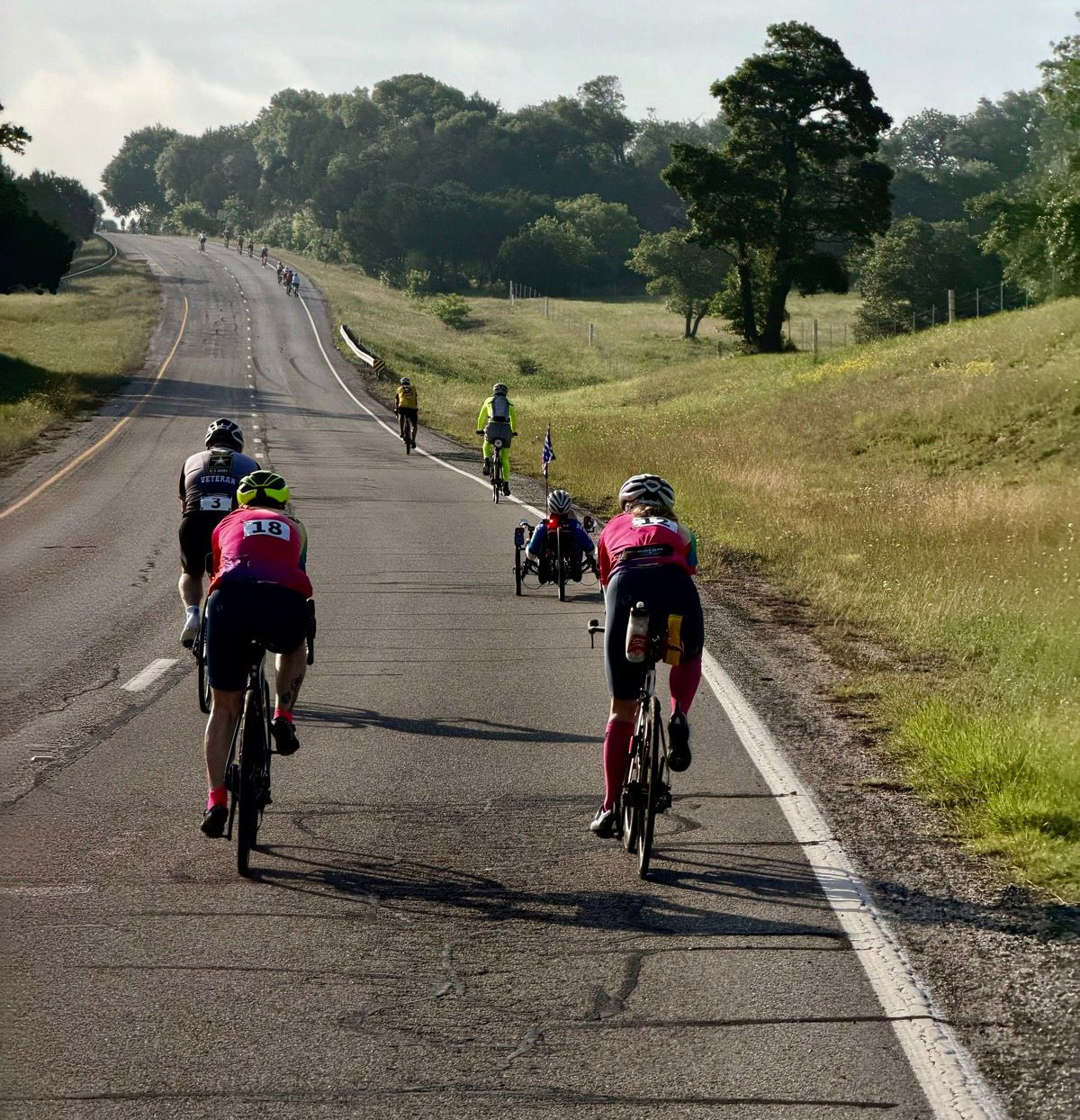
(Click image to see it larger.) I’m at nearly the exact center of this image, wearing the fluorescent yellow kit, heading up one of the longest climbs of my life. Thanks to Richie McDonald for the photo, taken during the “2026 Belton Lions Club Stampede on the Chisholm Trail Bike Ride”, held in Bell County, Texas, on May 9, 2026.
Cycling Background
Right now, my new interest/hobby is cycling. Sure, just like you, I learned to ride a bike as a kid (mine was a second-hand Japanese kid’s bike, bought in Tokyo, where I lived at the time). My second bike was a BMX-style that I received for my 10th birthday. I rode it until I was too tall for it, and then that was it. I went to college, had jobs, got married, had kids, moved half a dozen times, and hadn’t thought about riding a bike in decades.
I bought a bicycle about the time my children were riding around on training wheels. I don’t remember exactly when I got it, but maybe 2017? The idea was that my son was getting fast on his bike, even before we took off the training wheels, and I was getting tired of chasing him on foot. So I went to a sporting goods store (Academy Sports) and bought an Ozone500 Gira Terreno, which seemed pretty expensive to me at the time (on sale for $300). I had not yet heard of Big Bike and the assorted high-price brands, mainly because pro cycling isn’t promoted in the U.S. and I honestly didn’t know it still existed. I rode that bike on-and-off for a few years, keeping up with my kids — especially during the worst of the Covid pandemic, when the kids were schooling from home and I used daily bike rides as their P.E. classes.
I still didn’t consider myself a cyclist. I was just a dad who had a bike and rode with his children on the multi-use path in our neighborhood. (It’s about a one-mile loop.)
Pullup/Fitness Journey
Fast-forward to 2024/5, when I embarked on my pullup journey. It started at a public park when I discovered I couldn’t do a pullup anymore. I bought gymnastic rings, installed them in my garage, and worked several times a week until I could (and still can) do several pullups per set (see the video). During that time, I kept adding more exercises (pushups, curls, crunches, planks, press, etc.) and it dawned on me: my bike is RIGHT THERE. It was just sitting in the garage, waiting to help me on this new fitness path.
So I started riding it regularly (latter half of 2025). Almost immediately, I wondered if there was an app that could use the GPS in my phone to track my route. Mainly I just wanted an approximate distance of the ride, so I could calculate with an approximate time and get my approximate speed. Turns out there are multiple apps for exactly that, including Strava (#NotSponsored), which had both free and paid versions. It tracks the route, the time, the speed, and a ton of other bits of into, which was more than I needed.
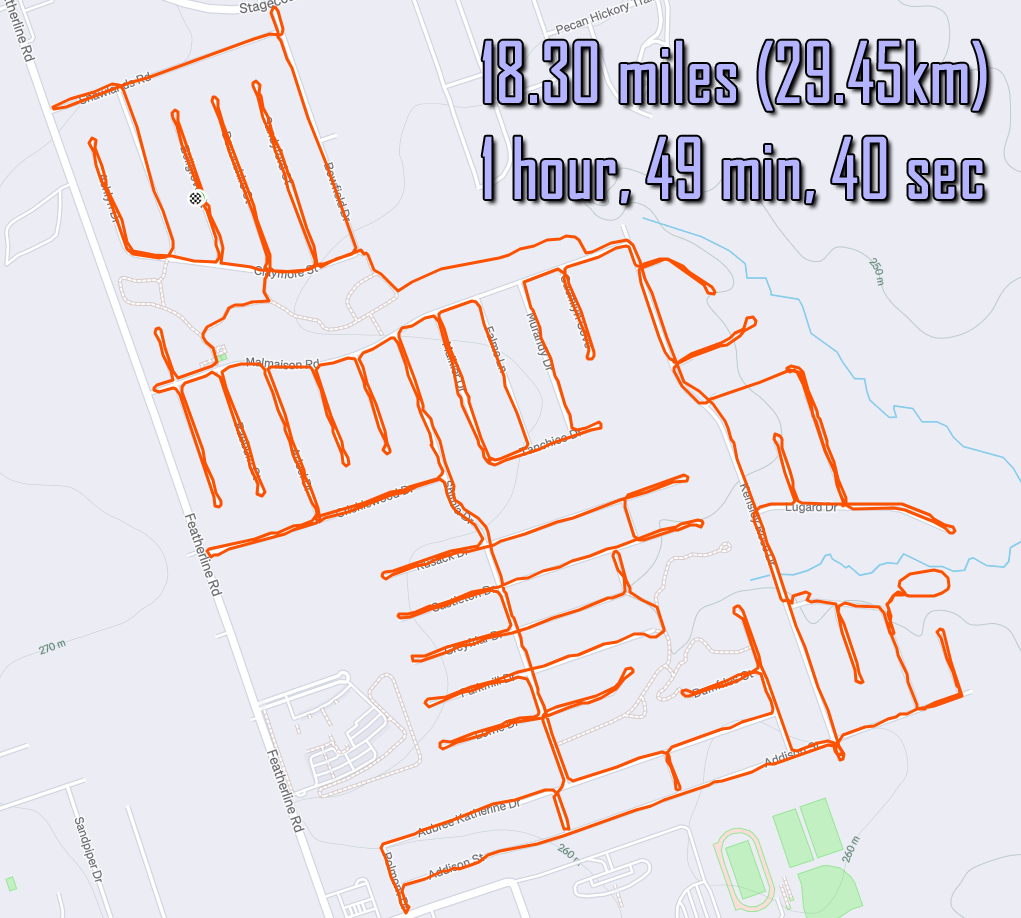
On Nov. 12, 2025, I rode every street in my neighborhood, which included a ton of doubling back since most streets are cul-de-sacs. It took nearly two hours to cover the 18+ miles. The map here was produced by Strava. (Click to see it larger.)
I started making little challenges for myself, charting routes throughout my extensive housing development (which includes two multi-use paths) and many miles of residential streets. By November 2025, I challenged myself to ride the entirety of my neighborhood (see related image), which took nearly two hours and covered more than 18 miles (see it on Strava if you have an account). I averaged 10.0 mph for that ride.
From there, things just snowballed. One cool thing about keeping track (both with Strava and in a spreadsheet file at home) is that it’s easy to see a past result and wonder if I can beat it next time. Can I go faster? Further? Last longer? I started venturing out of the neighborhood, learning to ride on bigger roads, find safer routes. By January, I was surpassing 30 miles occasionally, and in April I went 40 miles in one ride. I started pushing my average speed, aiming for 12 mph and then 13 mph. On hills, I tried to beat my maximum speed (currently 36 mph). I convinced my son to come with me on several rides, including one over 20 miles.
G.A.S.
As with most hobbies/interests, there comes a period of G.A.S. — gear acquisition syndrome. I bought a helmet (hypocritcally, I wanted my son to wear one when he rode, but didn’t have one for myself). I bought gloves, water bottles, bottle cages, saddle bags. And another helmet (a less vented one for colder weather).
But I’ve been through the stages of G.A.S. before, mainly with photography, but also with chess and woodworking. So I think I did well with keeping myself in check, and with choosing budget options. I didn’t buy one of those $500 helmets; I got one for $30 at Target. My saddelbags are generic, a fifth of the price of higher-end models. My gloves were from Walmart, and the bottle cages from the bargain bin. When I finally put rechargeable lights on the bike, those were budget models too. When my shoelaces got caught in the chain, I didn’t switch to expensive cycling shoes; I just made sure my next pair of sneakers were the slip-on kind. When I decided my clothes should be brighter colors for visibilty, and long sleeve for sun protection, I didn’t buy $200+ cycling jerseys; I bought $10 hi-vis work shirts at Walmart and some store-brand compression shirts. Instead of the $500 Garmin cycling computers, I bought a $60 iGPSport BSC200S (to track the rides without running down my phone’s battery).
The Next Bike
When I finally had to take my aging bike to a bike shop because the rear wheel hub ground itself to a halt, and that cost over $100 to replace, I began thinking about a more expensive bike. (By then, I had watched several cycling videos on YouTube, learning about mountain biking, road cycling, gravel racing, and other categories. So I knew there were more expensive bikes out there.) It was a few weeks before the annual Income Tax Refund bonanza — when my wife and I usually splurge a bit on ourselves. I looked up hundreds of bike models from major brands, nearly threw up in my mouth a few times due to seeing some of the prices, and found one that (a) was under $1,000, which I had set as my limit, (b) was simple enough that I would understand it [many new bikes have hydraulic brakes, electronic shifters, electronic dropper posts under the seat, tubeless tires, etc], and (c) had a larger chainring than my old bike. That last bit was important, because I wasn’t having trouble going uphill, but running out of gears when going downhill.
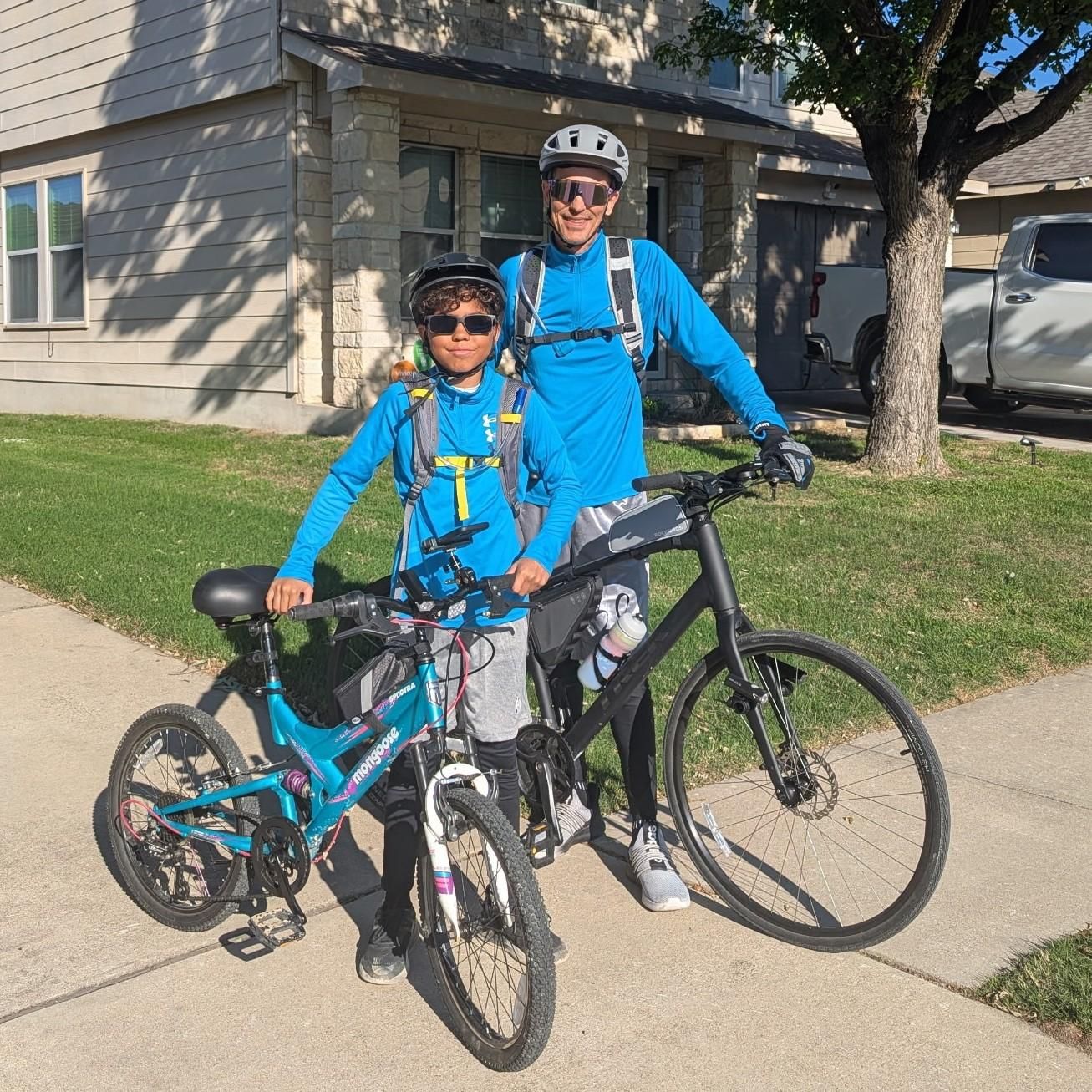
My son and I, in matching outfits, on April 19. He’s riding a Mongoose that used to belong to his older sister, and I’m with my new Trek FX1. On that day, we only went six miles, but a week later we rode 20.
My new bike, bought in early March 2026, is a Trek FX1. It’s not top-of-the-line. In fact, based on price, it’s bottom-of-the-line among the big bike brands. But it’s more than twice as expensive as any bicycle I had heard of before. It’s 10 pounds lighter than my old bike, has narrower tires (better for roads than for trails), and more attachment points for things like bottle cages, rear racks, and fenders.
Nutrition
One thing I learned from cycling videos on YouTube was the need for nutrition while riding. I had already noticed I was losing weight (not a good idea when you’re already slender like I was), and was trying to eat more. But I learned how to eat while riding — energy bars, or really any source of calories because I’m burning more calories while riding than I can replace by eating during the same time.
When my rides started going over three hours, I had to bring more water and food with me, so I got a two-liter hydration pack with extra pockets for snacks. As the weather began to warm up, I started sweating more so I have to be wary of how much sodium, potassium, and magnesium I’m losing during each ride and supplement those too.
Cycling Goals
When I started, my only real goals were (1) have fun and (2) maybe get healthier. But when 2026 started, I set a goal for the year of riding 1,000 miles. That sounded like a LOT. Maybe it would take half the year, if I stuck with it. But instead I passed 1,000 miles by early April.
So I set three new goals for myself, for 2026. One, ride 2,500 miles by year’s end. Two, crack the 50-mile mark for a single ride. And three, participate in an official cycling event. Not a race, because, dude, I’m getting old. But there are rides all over, I learned. And sometimes it’s more fun to ride with other people, or follow a route that someone else chose. Especially if that ride includes traffic control.
Stampede On The Chisholm Trail
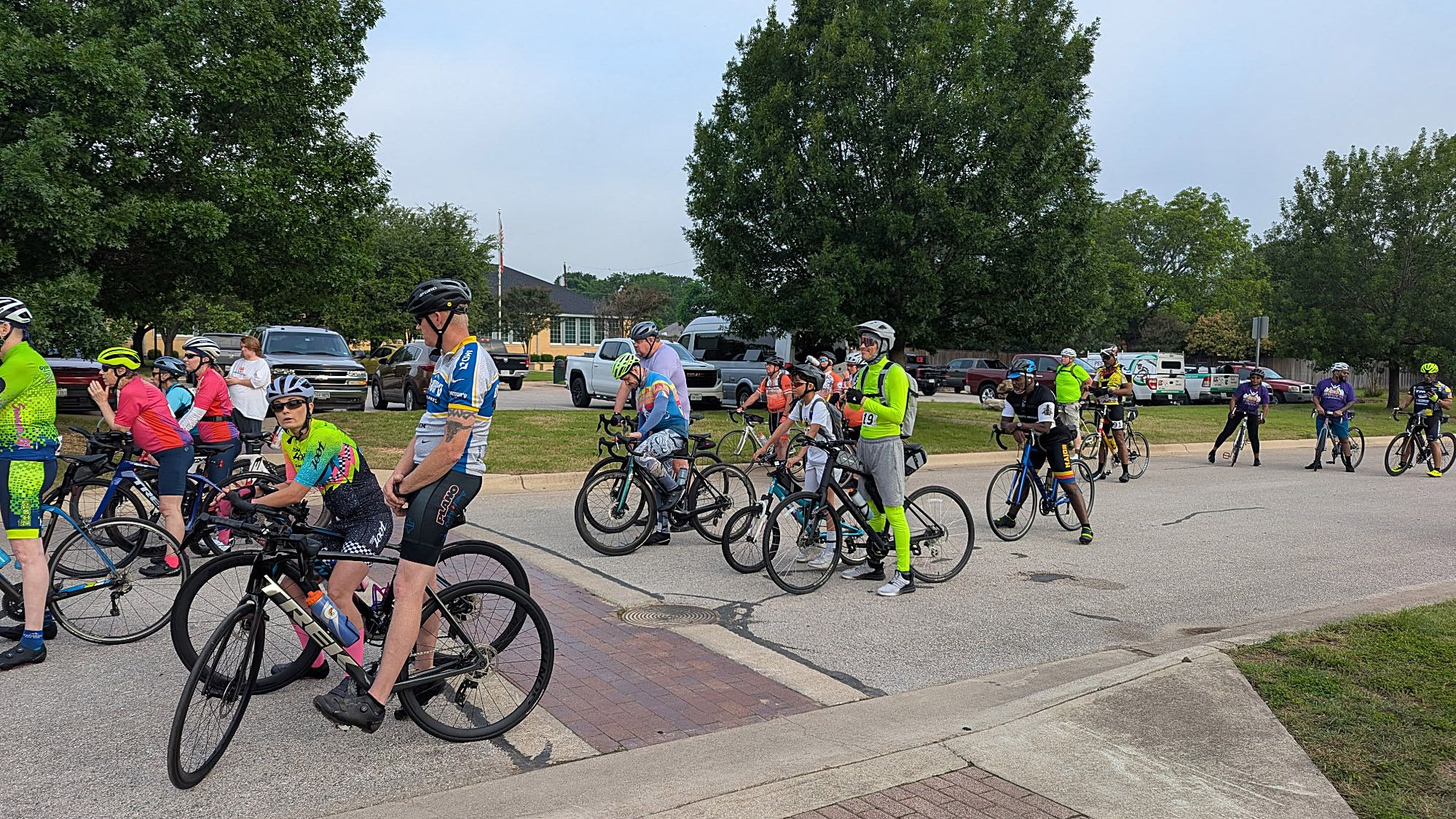
My son and I (center), near the back of the bunch just before the start of the Stampede on May 9. (Click to see it larger.)
I heard about the “2026 Belton Lions Club Stampede on the Chisholm Trail Bike Ride” from my local bike shop (King of the Mountain Cyclery), and looked into it. They had a “metric century” (62 miles) route, but also a 50-mile route, 30-mile route, and a 12-mile route. I thought I was ready for the longer two but my wife cautioned against it, so I signed up for the 30-mile route. And after learning that there would indeed be local police blocking traffic, I signed my son up for the 12-mile route.
It turned out to be an impressively well-organized event, with loads of volunteer work going into it. A local high school group sang the national anthem to get us started, the mayor said a prayer (because, yes, we’re in a theocracy here), other volunteers were cooking up the hotdogs we would eat upon our return, and police were already blocking the next couple of intersections. I didn’t count, but I would guess there were just over 100 riders in the event. My son was the youngest. The oldest was more than 80 years old. As far as I could tell, everyone was on a road bike or gravel bike (identified by the downward-curling handlebars) except for three: me, my son, and some guy on an electronic motorized “bicycle”.
My son surprised everyone by moving as soon as the gun was fired. We had lined up near the back of the pack, not knowing what to expect, but as soon as he could, Benjamin was off like a shot, weaving through the olds until he was at the front. And he kept up with them for a half-mile or so — the first major intersection. That’s where I finally caught up with him. But we wanted to ride at our own paces, so he dropped back and I moved forward. I found out later that he only went four miles and then called his mother for a ride. I was proud of him for trying, and can’t wait to ride with him again.
I’ve never ridden with other adults before, so I stayed away from clumps and groups, just trying to observe. Most seemed to ride alongside a friend or spouse. Two women riding together talked the entire time (which was frustrating when they caught up to me, just talking like it was easy, when I was pushing hard). We rode west out of Belton toward Nolanville. There was a feed stop near Nolanville. Those of us going further than the 12-mile route crossed I-14 and headed back east along the highway. That’s where I encountered the longest climb of my life (seen in the image at top). The riders in the distance just cruised up it, as did the man on the recumbent trike (seen in the top image just behind me), but I think I passed everyone else on that hill.
The turnaround point for the 30-mile ride was at Overlook Park next to Stillhouse Hollow Lake. I still had energy bars and half my water remaining, so I didn’t stop — though it looked like everyone else did. I just turned around and headed back. About that point, I realized I was making really good time. My previous best average speed was 13.7 mph back in March, and I had reached the halfway point at almost exactly one hour. So I was averaging nearly 15 mph and felt good despite the really long climb.
I noticed the police were no longer blocking traffic at intersections on the way back, so I had to play it a little more carefully, especially crossing I-14 and turning onto the access (frontage) road, but it was fine. A minute later, I realized that really long hill I had come up earlier had a benefit: I was going to go down it (just on the opposite side of the highway). That was fun — reaching speeds of 36 mph without pedaling and just trying to stay upright. Near the bottom, a car passed me (and the driver probably thought I was insane).
Also by that point, I realized I was alone on the course. The riders going on the 50- and 62-mile routes were still going south past the second feed stop, and the other 30-mile riders had all stopped at the feed stop when I didn’t. So I didn’t see another cyclist until I returned to the start/finish line. That part was pleasant. There weren’t many cars, the route was clearly marked with posted signs, there was little-to-no headwind.
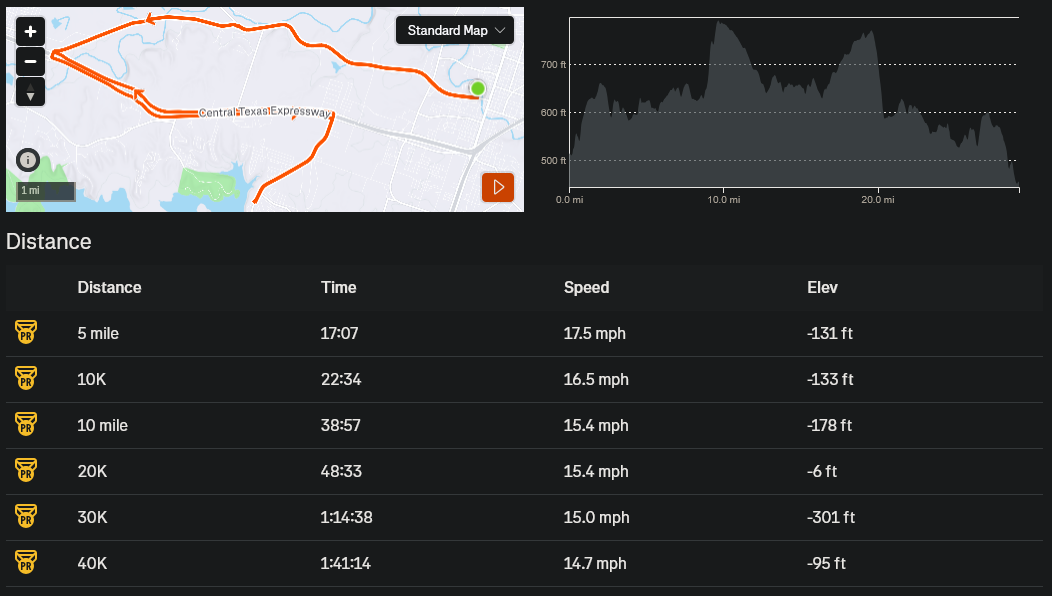
Screenshot of Strava’s “Best Efforts” page for my May 9 activity, showing PR (personal record) for each of the distances involved. (Click to see it larger.) The screenshot also shows a miniature map of the route and an elevation profile. The activity is here (must be logged into Strava).
I kept watching my cycling computer’s screen, calculating that I would finish at around two hours, and I did (2 hours, 1 minute, 5 seconds for 29.17 miles). The 14.5 mph average was far and away my best speed on any ride, and I set personal bests for all the distances that Strava tracks (5-mile, 10K, 10-mile, 20K, 30K, and 40K).
Upon arriving back at the park where we had begun, a group of volunteers cheered as I crossed the line and that felt nice. Other volunteers had food ready (included in my entry fee): a hot dog, watermelon slices, sugary carbonated drinks, and snow cones. I felt like Takeru Kobayashi as I made that hot dog disappear in seconds. There was also a vendor stand offering free samples of “hydration” packets — the electrolyte powders that you can mix in a water bottle. I had emptied my 2L hydration pack on the ride, but still had a 750mL bottle of water, so I mixed in a mango flavored Liquid I.V. packet and downed that in about five seconds.
I felt good. My butt was sore, my skin felt like a salt field, but I felt good.
And it turned out they had a bib number raffle, and both Benjamin and I won prizes (insulated stainless steel tumblers), which was nice. For the relatively small entry fee of $40, I felt like we got a lot out of the day — and I didn’t even mention the commemorative T-shirts that were included.
Conclusion
It made me want to do more events. Probably not competitive events, because —again — I would be the only one there with non-aerodynamic flat handlebars and not wearing Lycra. But maybe racing events. Maybe there’s an over-50 category where I would finish in something other than last place.
Before that day, I thought of myself as “a guy who rides a bike”, but now I feel comfortable saying “cyclist”. That was six days ago and I’ve ridden 70 miles since then. I hope to knock out 30 or 40 miles this weekend.
| Older Entry: | Carlsbad Caverns : Summer Trip 2022 |
|---|